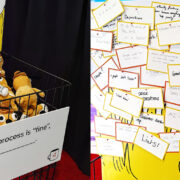
Last year, our RISKWORLD recap was a story about a missing shipping case, a borrowed TV, a hand-built booth, and a stack of stuffed “This is fine” dogs that somehow turned a logistical disaster into one of our favorite weeks of the year. As Paul put it in the email that broke the news to the team: “You’ll never believe this, but the exhibit services company has lost one of the cases for our booth. The ‘this is fine’ meme might be closer to reality than we anticipated.”
Reader, it was.
So when we started planning for RISKWORLD 2026 (May 3–6 at the Pennsylvania Convention Center in Philadelphia) we had a couple of goals. First: actually get the booth there this time. Second: bring back what made last year work — the dogs, and the willingness to show up human. And then we add a few new things we’d been excited about for months.
Here’s how it went.
What We Were Looking Forward To
The dogs are back
If you took home one of our “This is fine” plush dogs last year, they have siblings now. The dog-in-a-burning-room meme remains the most accurate metaphor for claims and risk management ever produced, and we weren’t about to retire it after one year. We brought a fresh batch to Philadelphia, and they went fast again.
The whole team came
Last year, a small crew held down our improvised booth in Chicago. This year, we brought the full APP Tech team to Philadelphia, and for many of them it was their first RISKWORLD. Watching teammates take in the scale of the show for the first time — the Marketplace floor, the keynote stage, the sheer density of risk professionals in one place — was one of the highlights of the trip. It’s one thing to build software for this community. It’s another to stand in the middle of it.
A new daily question board
We wanted to give people a reason to swing by Booth #1930 more than once, so we added a daily question board. Every morning we posted a new risk-related question — the kind of thing you’d actually argue (or laugh) about with a colleague over coffee — and invited attendees to write down their answer and pin it for the rest of the floor to see. By the end of each day, the board had become a real-time snapshot of how the industry was thinking about a single topic, in their own handwriting. More on what we learned from it below.
Sessions and Speakers That Stuck With Us
While APP Tech has been attending RISKWORLD for more than ten years, this was only my fourth. It’s a significant industry event that gathers regional RIMS members from across the globe, international and regional vendors, and noteworthy subject matter experts. To keep it memorable and an engaging experience for everyone we encounter, it has become a tradition for APP Tech to do our best to stand out amongst the vendors in the Expo Hall.
Although we were awarded RIMS best small booth in show in 2023, we are always looking for novel marketing techniques. The expo hall was especially dynamic this year since RISKWORLD placed multiple educational sessions led by various subject matter experts. With such variety offered, it’s all the more important to conduct prudent discernment beforehand on how to invest your time at the event.
With some familiarity of the RISKWORLD audience, experts, and desired outcomes, here’s what stood out for our 2026 experience:
- The keynote by the youthful Adam Grant for sharing how being genuinely humble is a proven way to accelerate your growth.
- The highly educational and inspiring session offered by Kirsty Altis-Downie from The University of Melbourne on how her “team of one” provided the vast university landscape with insight that clarified risk and provided exposure to future potential risk.
- David Tibbetts, Chief Safety Officer, Highwire who clarified the continuing problem of SIFs in construction, insight on the ongoing challenge and hope for a better path forward.
Keynote with Adam Grant
First, I should mention that the keynote kicked off after the acknowledgement of several RIMS contributors by the RIMS VIPs. No matter what industry you are in, it’s worthy to acknowledge the people and the source of inspiration they provide that shapes the industry and individual careers. To inspire those present in the 2026 audience, RIMS brought Adam Grant.
Adam is an organizational psychologist, an author and a public speaker who has also been featured on TED Talks. He was high-energy while also remaining humble. Stating this may seem like a contradiction, but his presentation left the audience with tactics they can apply immediately to their work environment. A key topic included how managers present themselves to the people they manage.
After explaining what an organizational consultant does, Adam first went on to share some sage professional advice. Instead of building a “support network” he argued that you would be better off with a “challenge network”, i.e., people who are willing to share unpleasant truths instead of enabling you to continue down a bad path. I think Hans Cristian Andersen made the same point in the fable of “The Emperor’s New Clothes.”
There were several worthy points covered in his presentation, but here are a few that stood out to me:
- Raise problems before you know how to solve them. This was Adam’s counter to the manager who says, “Don’t bring me problems, bring me solutions.” That stance sounds decisive, but it quietly trains people to sit on issues until they’ve got a fix in hand. In a risk environment, a buried problem is just unmanaged exposure. The better message: bring me anything, as long as you’re willing to be part of the solution.
- Model the behavior you ask for. “If you see something, say something” isn’t enough coming from management. It’s a slogan until you demonstrate it. Adam’s recommended next step is to criticize yourself out loud in front of your reports. Doing so resets the perspective of everyone listening: instead of claiming you’re open to the truth, you prove it. When Adam showed a willingness to do this, he said the floodgates of feedback opened.
- You can’t hide your own weaknesses since people already know them. Trying to conceal them only costs you credibility. Naming them first does the opposite. It reminded me of the communication principle attributed to Microsoft’s Steve Ballmer: bad news should always travel the fastest.
- Think like a scientist. Don’t let your ideas become your identity. Leaders who treat their conclusions as hypotheses rather than convictions make better decisions and pivot away from bad ideas faster. It’s the antidote for anyone who’s quietly certain their way is always the best way.
Case Study Australia (Show and Tell)
Before sharing her methodologies and results, Kirsty Altis-Downie set the scene by describing the sheer diversity of projects in play at The University of Melbourne. They are working on everything from wildlife rehabilitation efforts to underground labs. When she was first asked to gauge the risk exposure across that landscape, she found that the relevant information lived almost entirely in the heads of individual project managers. If she was lucky, she’d find a spreadsheet.
That was the “before” picture, and it framed her central lesson: the problem usually isn’t a shortage of data. It’s that people are blinded by the overabundance of it. They need someone who can help them see what the data could tell them once it’s harnessed properly, and who can flag when key data is missing altogether.
From there, Kirsty walked through how her “team of one” turned that scattered, siloed information into something the university could act on. A few principles stood out. Secure top-level buy-in, but accommodate the people on the ground who actually do the work. Summarize results so they’re digestible rather than overwhelming through maps, trend lines, and views that let stakeholders filter by their own area of interest. And wherever possible, connect lessons learned back to dollars saved, because that’s the language that keeps a risk program funded.
Rethinking Safety Metrics
Another session of interest was led by David Tibbetts, CSP of Highwire, on “Rethinking Safety Metrics: How Tracking SIF-Potential Transforms Risk Management.” David opened with a slide comparing 30 years of fatality and recordable rates. The pattern was striking: while recordable rates have continually dropped, the fatality rate has hit a plateau floor of roughly 9.1 to 10.2 deaths per 100,000 full-time workers across the past 28 years.
His explanation for that divergence was the heart of the session. We measure what matters, and what gets measured improves so it follows that recordables have steadily improved because that’s what the industry has been measuring. SIFs (serious injuries and fatalities) have plateaued because they’re a different kind of event, driven by exposures that recordable-rate tracking doesn’t capture. David’s argument: recordables need to be complemented by assessing SIF risk. Identifying conditions with the potential to result in a SIF, then categorizing related events as potential (pSIF) or actual (aSIF).
He went on to outline three ways that chasing lower recordables can backfire: owners or general contractors cutting a trade contractor over an elevated TRIR without understanding the details behind it; teams celebrating low or zero recordables without asking the harder question of how they’re capturing pSIFs and exposures in the first place; and owners who set aggressive low-recordable targets and end up grandstanding over minor injuries like a laceration or a sprained ankle. Different as they are, they all point to the same “Zero Recordable” trap: when incidents go unreported, or when the absence of a recordable is wrongly equated with the absence of risk, you lose the transparency you need to learn from exposures and near-misses. How do you invite and enable that transparency?
David and others in the industry are already promoting ASTM E2920-26 (published January 2026), which keeps all recordables from being treated the same so that pSIFs are properly captured. This is where the incident-based orientation of Cloud Claims fits naturally: by capturing exposures and near-misses, not just recordables, it lets teams monitor and address pSIFs with the goal of preventing aSIFs. Given the importance of the standard, sessions like this are another good reason to attend RISKWORLD so you can get the chance to learn from peers and industry innovators is hard to replicate.
What We Heard at Booth #1930
We work to keep the booth experience not only fun for the people at the event, but it should also be a good experience for my peers who man the booth. We again used our unofficial mascot “Houston” which proved popular enough to draw people to engage with us at the booth. To keep things interactive and relevant to our software offering, we used a game where participants could post an answer to a physical board for people walking by our booth to see.
Day 1 Question: My claims process “is fine” except for _____.
On day one, it was a fill in the blank sentence: My claims process “is fine” except for _____. Although the participants could complete the sentence however they wish, it was interesting to see that we only had a few different ‘types’ of answers. The overwhelming answer was, “it’s me” or rather “us”. Of the 41 responses collected from attendees on day one, 20 of the responses indicated that the largest frustrations came from interactions with others. Significantly behind in second place came “time” or lack of expedited responses (e.g., “Speed!”, “It’s slow.” and “It’s really slow”). And in a practical three-way tie for third came ‘technology, red tape’ and ‘the sky is falling’.
What can we learn based on our responses from day one? I believe that the number one response for me should be to listen. While we hopefully always listen to understand and guide our intended response to address the problem being discussed, we should also listen to enable us to walk in the shoes of the person we are talking with. Having you as their advocate will give them hope and it can fuel your efforts to save them from the misery they encounter. If it’s not obvious, we should ask “how would solving this problem improve your work, help the business, improve customer experience?’”
Question for Days 2 & 3: If your worst claim were a movie, what would the title be?
For the second and third day, we used a question that was intended to stoke the imagination – “If your worst claim were a movie, what would the title be?” Although several respondents used popular movie titles (e.g., Titanic, Die Hard, Sharknado), there were a few original titles that painted a picture or got you curious.
The following are some examples of movie titles that painted a picture:
- Lawn mower fire next to full can of gasoline
- Poop cruise
- The Million Dollar Leg
Others that got us curious included the following:
- The case for professional boundaries
- Why I need Xanax
- Tourist in Afghanistan
- Replacement Nightmare
Unfortunately, I can only recall the background for the last one as it was a joint effort. Our guest at the booth shared the story of a driver who found a replacement since he was sick. That’s the end of the good news. Here’s the bad news: the replacement did not have a valid CDL, was intoxicated, and had drugs in his system. We only know this thanks to the investigation of an accident where the replacement driver drove his rig into a school bus that was then propelled into a minivan full of senior citizens. While you may never forget this story, I’ll never forget the look on the face of the lady who shared this story. I could see that recalling this event brought her back to a disturbing time.
Why RISKWORLD Was Worth It (Again)
We can say it plainly: this is one of the most valuable weeks on our calendar. The floor was busy. The keynotes were sharp. The stages were full of the kind of practical, in-the-weeds thinking that doesn’t always make it into the press release version of risk management. And our booth (for the record) arrived on time.
What stays with us most isn’t the sessions or the swag count. It’s the people. Risk and claims professionals are some of the most thoughtful, pragmatic, and (yes) funny folks we get to spend time with all year. They show up to work in the middle of someone else’s worst day and bring order to it. The fact that we get to build software for them is something we don’t take lightly.
A huge thank you to RIMS for putting on another standout event, to everyone who stopped by Booth #1930, to the team members and partners who made this our best RISKWORLD yet, and to anyone who took a “This is fine” dog home. You know who you are.
The event is aptly called RISKWORLD since we live in a world of risk. The thought of eliminating risk makes me think of a quote from Hellen Keller that I admire:
“Security is mostly a superstition. It does not exist in nature… Life is either a daring adventure, or nothing.”
Let’s Talk
If your current claims and risk processes still feel a little too on fire or if you missed us in Philadelphia and want to pick up the conversation, let’s talk. APP Tech helps claims and risk teams move from chaos to control with smarter, more adaptable, incident-based software.
Connect with our team and let’s talk about:
- What’s working (and what isn’t) in your current process
- How you’re managing risk events in real time
- What you wish your claims platform could actually do
We’ll bring the coffee. And yes, we still have a few stuffed dogs.
See you at RISKWORLD 2027.